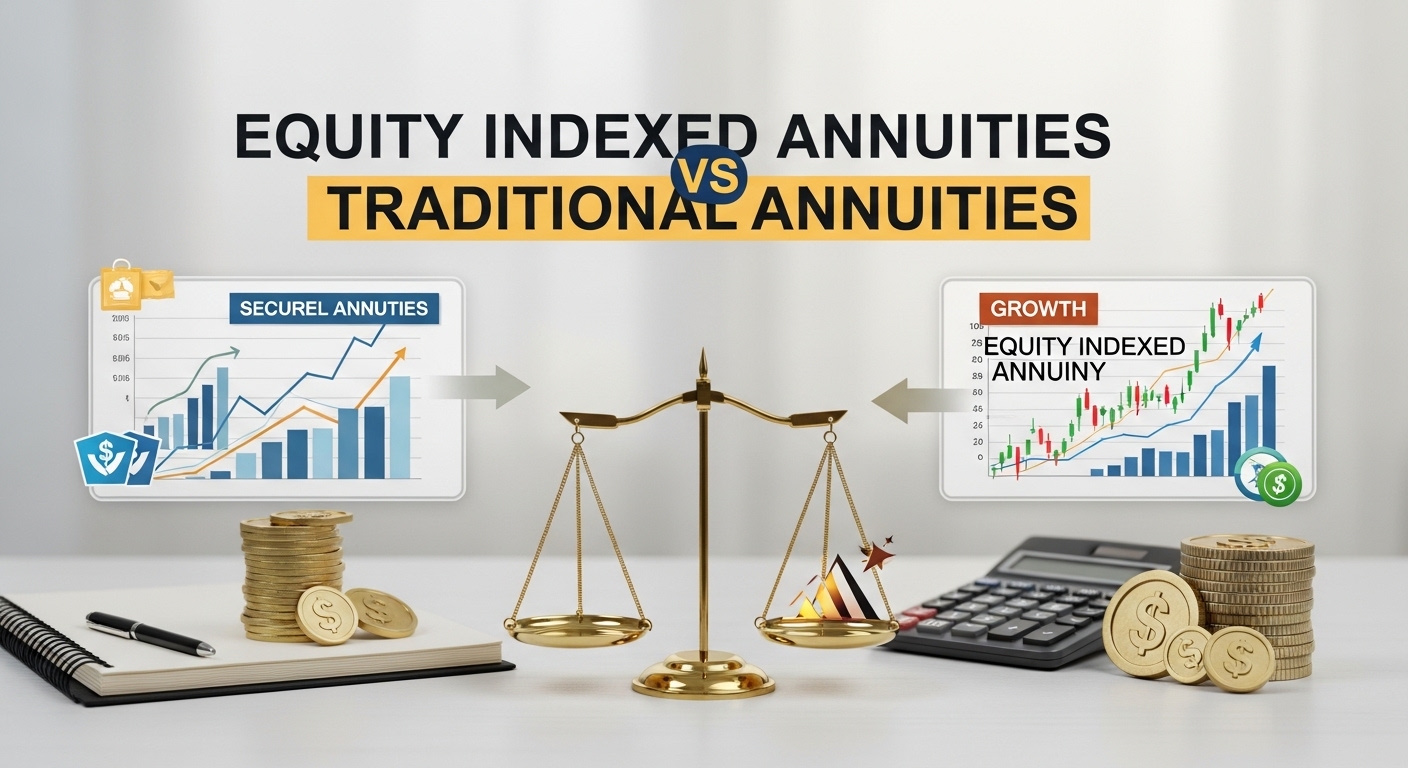
The financial world is changing quickly in 2025, which makes investors rethink their old strategies and look for safer, smarter ways to protect their money. The argument between “equity indexed annuities” and regular annuities has gotten even more heated as markets change and retirement goals change. A lot of investors want a mix of safety and performance these days, and the modern market is clearly leaning toward one option more than the other. To understand why, it’s important to look at how these products work, how they are different, and why smart investors in 2025 are making choices that weren’t as common in the past.
The global economy is now in a time of uncertainty. Traditional savings accounts and bonds don’t pay out much, and investments that are linked to the stock market can be very volatile, which can be too much for many retirees. This has made it the perfect time for equity indexed annuities, which are a mix of a regular annuity and a market-linked growth product. Even though traditional annuities are still useful, a lot of investors now think they are less useful than newer ones. The growing change in how investors feel shows how strong a product that meets both psychological and financial needs is: safety, predictability, and controlled exposure to market growth.
To understand this change, you need to look at what each type of annuity has and doesn’t have, as well as what investors really want today.
Table of Contents
How Equity Indexed Annuities Work Compared to Traditional Annuities
To have this conversation, we need to know how both types of annuities work. Traditional annuities are one of the oldest ways to save for retirement in the insurance world. They are great for conservative investors because they promise income and returns that are easy to predict. But they can’t grow very much because they depend on fixed interest rates that were set when they were bought. On the other hand, “equity indexed annuities” let investors earn returns based on how well a market index does without putting their principal at risk of losing money when the market goes down.
This mix of safety and chance makes the latter very appealing in 2025. Investors want guarantees, but they also want to be able to keep up with inflation and how the market is doing. Long-term inflation can be a problem for traditional annuities, but “equity indexed annuities” can help fill that gap.
An equity indexed annuity has a structure that includes participation rates, caps, floors, and market indexing formulas. These features make sure that the investor never loses their principal, even when the market goes down. Smart investors know that avoiding losses is just as important as making gains, especially when it comes to planning for retirement. On the other hand, traditional annuities stay the same, but they often can’t keep up with rising living costs, which makes them less appealing to people who want to be financially secure in the long term.
Why 2025 Investors Prefer Equity Indexed Annuities Over Traditional Options
In 2025, investors act in a way that shows they want more balance. In the past, people were either conservative or aggressive. Now, investors are a mix of the two. They want to be a part of the growth of the market, but they don’t want to have to deal with the stress and cost of market downturns. This is exactly why more people are interested in “equity indexed annuities.”
Annuities that are traditional guarantee returns, but they can’t do better than the market. In a world where inflation is rising, a fixed return that seemed fair in the early 2000s is no longer enough. Today’s retirees need products that stay in line with the economy, and “equity indexed annuities” offer the chance for growth that beats inflation.
Another main reason smart investors like these products is that they make them feel better about their investments. People feel better about their money when they know it won’t go down because of changes in the market. The contract floor protects the investor’s account from losing value, even if the index does poorly. This is a kind of guarantee that traditional annuities also offer, but without the chance for more growth. So, both products help with fear, but only one gives you hope for bigger gains.
Also, “equity indexed annuities” often come with extras like death benefits, income riders, and tax-deferred growth. These extra tools make a retirement plan that regular annuities can’t match.People who put money into 2025 want products that can change and adapt, not ones with fixed structures that stop their money from growing.
Comparing Risk Levels in Equity Indexed Annuities and Traditional Annuities
How people see risk is a big part of choosing an annuity. People often think that traditional annuities are very low-risk because they offer fixed returns.But this view hides another kind of risk: the loss of purchasing power. If inflation rises faster than the fixed interest rate of a regular annuity, the investor loses real value over time.
equity indexed annuities, on the other hand, are set up to protect against market losses while still allowing for growth linked to an index. This means that the investor doesn’t have to worry about losing money if the market goes down. This may look like the safest choice at first, but investors need to know what it can’t do. People who buy these annuities are not fully participating in the market. Instead, participation rates may limit or cap returns. Still, the controlled tradeoff is appealing because the investor is willing to give up some of the upside to get rid of all of the downside.
In 2025, smart investors put safety ahead of growth that never ends. They know that not losing a lot of money is important for building wealth over time. With this way of thinking, “equity indexed annuities” come out as a safer, more balanced choice than the unpredictable market and more growth-focused than regular annuities.
Growth Potential: Why Equity Indexed Annuities Win the Comparison
When it comes to retirement investments, the growth potential is a key factor. Most of the time, traditional annuities have fixed interest rates that don’t keep up with how well the stock market does. It’s nice that they are predictable, but it makes it harder to build wealth over time.
equity indexed annuities, on the other hand, are made to follow the performance of indices like the S&P 500, which means that the investor will get some of the market gains. Because of this structure, they are in a unique position to offer more growth than regular annuities can. People who invest in 2025 want products that fit with today’s financial markets, not old fixed-return models that don’t work well in economies with high inflation.
Also, investors can’t get all of the market gains because of caps or participation limits, but they still have more long-term potential than with regular annuities. The growth advantage is most obvious when the market is going up for a long time. As long as the index does well, the annuity will do the same up to its limit. The annuity doesn’t lose value even when the index does poorly.
This formula for growth without loss shows why “equity indexed annuities” are still the most talked-about retirement plans in 2025.
Retirement Income Planning and the Role of Equity Indexed Annuities
Planning for retirement means finding stable sources of income that will last for many years. People have liked traditional annuities for a long time because they provide income for life. Now, “equity indexed annuities” offer similar features and more growth options.
Income riders on equity indexed annuities let investors get guaranteed payments for life, just like regular annuities do. But these payments could get bigger over time because the annuity can grow through indexing. This makes them more appealing to people who want a steady income without feeling stuck in old ways of managing money.
A lot of people who will be retiring in 2025 are also worried about longevity risks. Retirees are at risk of rising living costs if they have financial products that can’t adjust to inflation in the market. “Equity indexed annuities” help lower this risk and stabilize lifetime income because they have the potential to grow.
Investors want to know that their money will be safe and stable over time. Annuities that offer both safety and chance naturally become the best choice.
Tax Advantages of Equity Indexed Annuities Compared to Traditional Options
Tax deferral is a big plus for both types of annuities, but “equity indexed annuities” have some advantages that become clearer over time. The annuity grows faster than a taxable account because gains are tax-free until withdrawals start. But these annuities may pay out more than regular annuities, which makes their tax-deferred benefits even better.
Tax planning is still very important for retirees in 2025. Smart investors know that “equity indexed annuities” work better when market-linked gains are combined with tax deferral. On the other hand, traditional annuities have lower returns, which makes the tax benefits less useful and makes them less competitive over time.
Why Equity Indexed Annuities Outperform Traditional Annuities in Market Volatility
In the last few years, the global economy has become known for its market volatility. Annuities that are traditional may seem like a good idea during times of chaos, but they don’t work during times of recovery. They keep giving the same fixed interest rate even after the market goes down, which means investors can’t get back the chances they missed.
Because of how they are set up, “equity indexed annuities” do well in markets that change a lot. The contract floor protects the principal during downturns. When the market goes up again, the annuity will do better because of the index. This is something that traditional annuities don’t have: they can stay stable in bad markets and do well in good ones.
Being able to deal with global uncertainty without giving up growth potential is a key factor for investors getting ready for 2025 and beyond.
Long-Term Wealth Protection with Equity Indexed Annuities in 2026
To protect your wealth over the long term, you need to choose products that can change with the economy. Even though traditional annuities don’t change, they can lose value over time because they are fixed. equity indexed annuities, on the other hand, help investors keep their money safe because their returns follow market trends.
These annuities protect the investor from big losses while still letting them make money that is in line with the economy. This mix lets retirees and people who plan for the long term keep their money safe while still leaving the door open for future growth.
Key Differences Between Traditional Annuities and Equity Indexed Annuities
The differences between the two types of annuities show why one is becoming more popular with investors in 2025. Traditional annuities are easy to understand, predictable, and have fixed rates. equity indexed annuities, on the other hand, go beyond these limits to offer structured growth opportunities with limited risk.
This difference is why many financial planners now suggest indexed annuities as a way to solve modern investing problems.
How Equity Indexed Annuities Strengthen Retirement Portfolios
A good retirement portfolio has stability, growth, and ways to manage risk. “Equity indexed annuities” make portfolios stronger by giving them all three things at once. Balanced strategies are especially useful for investors who want to find a balance between risk and reward because they provide a stable base while also opening up the possibility of market-based improvement.
Indexed annuities change as the market changes, unlike traditional annuities, which stay the same over time. This dynamic nature really appeals to investors in 2025 who want retirement plans that can change.
Conclusion
In 2025, there is a clear trend when you compare traditional annuities to “equity indexed annuities.” Investors are no longer happy with fixed, unchanging financial products that don’t keep up with inflation or the market. They want safety, but they also want a chance to succeed. They want to grow, but they don’t want to lose. They want a steady income, but they also want to be able to change. There is only one type of annuity that offers all of these things.
For some investors, especially those who value simplicity and guaranteed returns, traditional annuities will always be useful. But the modern financial world has made it more important to have hybrid solutions that offer both safety and performance. “Equity indexed annuities” meet this need by giving you market-linked returns without the risk of losing your principal.
In 2025, smart investors know that making plans for the future means making smart choices that fit with how the economy really works. As uncertainty continues to shape global markets, indexed annuities stand out as the best choice for retirement planning because they offer both security and growth.
FAQs
Q1. What makes Equity Indexed Annuities different from traditional annuities?
Unlike regular annuities, which only offer fixed returns, they offer both principal protection and growth linked to the market.
Q2. Are Equity Indexed Annuities good for retirement income?
Yes, they have guaranteed income options and the chance of higher payouts because the value of the index grows.
Q3. Do Equity Indexed Annuities carry market risk?
No, the principal is safe even if the index does poorly.
Q4. How often does interest crediting occur in Equity Indexed Annuities?
Depending on the terms of the contract, crediting could happen once a year, once a month, or at the end of the term.
- Q5. Are Equity Indexed Annuities suitable for long-term planning in 2025?
They are very good because they offer both growth potential and protection against market downturns.